

Gary J. Sullivan (SC 29 chair)
April 2026
Scope of ISO/IEC JTC1/SC 29
Standardization in the field of
- Efficient coding of digital representations of images, audio
and moving pictures, including- Conventional (natural, computer-generated and immersive) images,
moving pictures and audio - Invisible light and other sensory (such as medical and satellite) images
- Static and dynamic graphic objects
- Conventional (natural, computer-generated and immersive) images,
- Efficient coding of other digital information, including
- Multimedia, environment and user related metadata
- Sensor and actuator information related to audiovisual information
- Other digital data in agreement with the relevant committee, such as
genomics
- Digital information support, including
- Synchronization, presentation, storage and transport of single or
combinations of media - Media security and privacy management
- Quality of Experience evaluation and system performance metrics
- Synchronization, presentation, storage and transport of single or
Highlights
- About 75 standards under development, more than 600
standards published, 31 P-members, 17 O-members, >1000
experts, ~500 attending WGs quarterly - Reorganized in 2020: MPEG (WG 11) became MPEG WGs 2-8
and AGs 2, 3, 5 - Most convenor terms and chair term renewed for 2024-2026,
one advisory group retirement replacement appointed for 2025 - Highly-prominent standards recognized by ten Emmy awards
(four within the last 5 years, ISO Base Media File Format,
DASH, Open Font Format, and CMAF) - Recent standards for Versatile Video Coding, JPEG XL Image
Coding, JPEG XS Low-Latency Image Coding, JPEG AI Image
Coding, JPEG Trust Authentication & Provenance, 3D Audio,
Point Cloud Coding, Neural Network Coding for Media,
Immersive Video, Smart Contracts for Media, Common Media
Application Format, Genomic Coding, etc.
New areas
New areas & explorations: Media trust authentication &
provenance, Video coding beyond VVC capability, Plenoptic &
holographic light fields, Lenslet image & video coding for dense
light fields, Point cloud coding, Dynamic mesh coding, Avatars
for visual communication, Generative face video coding,
Advanced genomics features & technologies, image storage as
DNA, Visual event coding, Haptics, Non-fungible tokens,
Incremental neural network compression, Neural network-
based image, video and graphics coding (JPEG AI / NNVC),
Audio and video coding for machine analysis, Immersive audio,
Media for immersive applications and immersive rendering-
based displays, Implicit neural video representation, Neural
radiance fields, Gaussian splatting
Artificial intelligence / machine learning / neural networks
in media coding and applications is a pervasive recent theme
Rules & procedures
- Basic rules
- Directives Part 1 JTC 1 Consolidated Supplement (2024, to
change in 2026): Procedures - Directives Part 2: Drafting
- Resources
- Drafting Standards & ISO House Style
- New: Online Standards Development
- ITU-T/ITU-R/ISO/IEC Common Patent Policy
- WGs are established by SCs to develop work items
(Therefore, a WG cannot exist without at least one work item)
- Directives Part 1 JTC 1 Consolidated Supplement (2024, to
- Each WG and AG has a Terms of Reference description
- SCs consist of NB delegations, operating by P-member voting
- WGs consist of P-NB-qualified experts, operating by consensus
- SCs have (term-limited, Secretariat-selected) chairs; WGs have
(non-term-limited, NB-nominated, SC-selected) convenors
Approval: Committee, Enquiry, Publication
- International Standards (ISs): NP/NWIP (12)/Request -> [WD] -> [CD/CDAM] -> DIS/DAM -> WG Completion [FDIS/FDAM] -> Publication
- Technical Reports (TRs): Request (0-4) -> [WD] -> [CDTR] -> DTR ->
Publication - The NP/NWIP/Request phase can be somewhat merged with others
- Square bracket stages can sometimes be skipped
| Circulation type | Preparation | Translation | Commenting | Total |
| CD/CDAM/CDTR | 8 weeks | 8 weeks | ||
| (first) DIS/DAM | 2 weeks | 8 weeks | 12 weeks | 22 weeks |
| Subsequent DIS/DAM | 2 weeks | (none) | 8 weeks | 10 weeks |
| (first) DTR | 6 weeks | 2 weeks | 8 weeks | 16 weeks |
| Subsequent DTR | 2 weeks | (none) | 8 weeks | 10 weeks |
| DCOR | 12 weeks | 12 weeks | ||
| FDIS/FDAM | 6-12 weeks+ | 8 weeks | ~16 weeks |
Tools & operations
- ISO Documents
- JPEG extensively uses the Member Area
- Other groups document working methods there
- ISO Meetings
- All groups should have a 2+ year planning horizon
- Most meetings use 2 registrations in practice (ISO & Host)
- WGs & AGs typically have 4 meetings/year (and SC 29 has 2)
- Most meetings are (best-effort) hybrid
- ~1 meeting per year has been virtual; this is no longer required
- ISO Projects
- Mostly used by the official editors
- Online standards development (OSD) new drafting system
- jpeg.org & session calendar
- mpeg.org & mpeg.expert session calendar and DMS
Drafting guidance
- Drafting Standards page and Resources on ISO website
- Templates and Rice example (Foreword, Introduction, 1. Scope, 2.
Normative references, 3. Terms and definitions) - House Style guidance
- Verbs
- “shall” or “is required” is a command; don’t use it in a TR or a NOTE
- “shall not” is similar
- “should” or “is recommended” is not, but don’t use in a TR or NOTE
- “may” or “is permitted” is permission, not possibility
- “can” or “is possible” is possibility
- Don’t use “may not”
- Avoid other words (“must”, “could”, “might”, “needs to”, “has to”)
- When in doubt, avoid using figures
- If you use them, check and follow the rules
- Small errors in figures can become problems and cause delays
- Lowercase titles, clause/subclause headings, and defined terms
- Use Oxford spelling (also used by the UN and thus the ITU)
- organization, signalling, colour, neighbour, but analyse
- There are special rules for formulae (not “equations”) and pseudocode
- Automatic numbering and cross-references are problematic
- No hanging paragraphs
- No clauses and subclauses called “Introduction” (use “General”)
- Clearly refer to every annex, using “shall” if normative
- Turn off automatic language detection
- Use Canadian (or British) English language identification
- Use Cambria font (Courier New for pseudocode)
- Set field code shading to “always”
- Learn how to edit field codes (use print preview, search “not found”)
- Provide a zipped copy of the software if there is software
- Use the MXM software license; make the license(s) easy to find
- Turn on viewing of white space characters
- Turn off automatic capitalization of table cells and sentences
- References go in two different places:
- Normative references (Clause 2) for documents used as definitions
and in “shall” statements - Bibliography (at the end of the document) for informatively
referenced documents - All referenced documents need to be referred to (clearly)
- Normative references (Clause 2) for documents used as definitions
- If the text refers to a specific location in a referenced document, the
reference needs to be a dated reference - To refer to the current document, use “this document”
- All defined terms need to be used in the document
- Definitions should not start with “a” or “the”
- Don’t discuss development process or WG or plans in a standard
- Some (not all) standards & TRs can be published for free by request
- There are slightly different rules for joint standards (e.g. with ITU-T)
Some neural network-related projects
- Neural Network Coding published 2022
- ISO/IEC 15938-17, to compress representation of a neural network
- 2nd edition 2024 with incremental compression
- JPEG AI learning-based image coding
- To compress pictures using neural network technology
- ITU-T T.840.1 | ISO/IEC 6048-1, finished (v1) in 2025
- JPEG Pleno learning-based point cloud coding
- ISO/IEC 21794-6, finished 2025
- Optimization for machine analysis of coded video content
- ITU-T H.Sup-MACVC | ISO/IEC CDTR 23888-3
- Draft Technical Report in progress, to finish mid 2026
- Video Coding for Machines
- ISO/IEC CD 23888-2, completion 2026
- Feature coding for machines
- Call for Proposals April 2025
- Neural Network Video Coding exploration in Joint Video Experts Team
Developments in JPEG AI
- JPEG AI (ITU-T T.840 | ISO/IEC 6048)
- Version 1
- Part 1 IS / Recommendation published in 2025
- Part 2 Profiling IS is issued by WG 1 in July 2025
- Part 3 Reference Software IS is issued by WG 1 in July 2025
- Part 4 Conformance DIS under ballot
- Part 5 File format IS is issued by WG 1 in July 2025
- Compression efficiency gains between 12.5% to 27.9% over the
VVC Intra coding anchor, with a wide range of complexity tradeoffs
(7 to 216 kMAC/px) at the decoder side - JPEG AI Version 2 is under discussion
- JPEG AI requirements not yet addressed in version 1, e.g.
related to processing and computer vision tasks - Significantly improved solutions for JPEG AI requirements
already addressed in version 1, e.g. compression efficiency
- JPEG AI requirements not yet addressed in version 1, e.g.
- Version 1
Developments in video coding
- Versatile video coding (ITU-T H.266 | ISO/IEC 23090-3)
- Finished (v1 publication) in 2020
- Now approaching v4, coordinated with VSEI
- Roughly 50% bit rate savings over HEVC (eq. perceptual quality)
- Low-complexity enhancement video coding ISO/IEC 23094-2 in 2021
- MPEG immersive video ISO/IEC 23090-12 in 2023
- Next-generation video coding exploration in Joint Video Experts Team
- Enhanced Compression Model: Classical-style signal processing
- Roughly 28% savings over VVC (random access config.)
- Neural Network Video Coding
- Hybrid tools approach
- Intra prediction
- Super-resolution
- Post-filter
- Loop filter (VLOP 10 kMAC/pxl 6%, LOP 22 kMAC/pxl 8%, HOP 14%)
- Hybrid tools approach
- Enhanced Compression Model: Classical-style signal processing
- Joint Call for Evidence issued: Response evaluation Oct 2025
- Draft Call for Proposals new std: Response submission Nov 2026
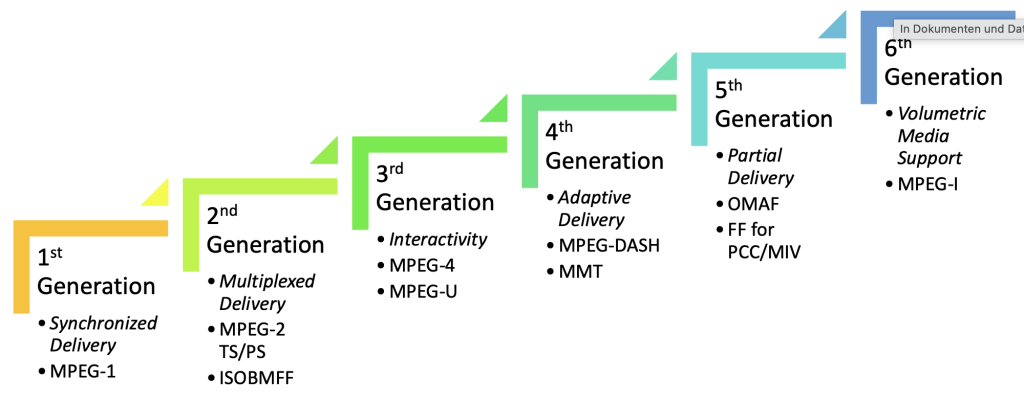
MPEG Systems technologies
New ITU Partnering: Biomedical Signals
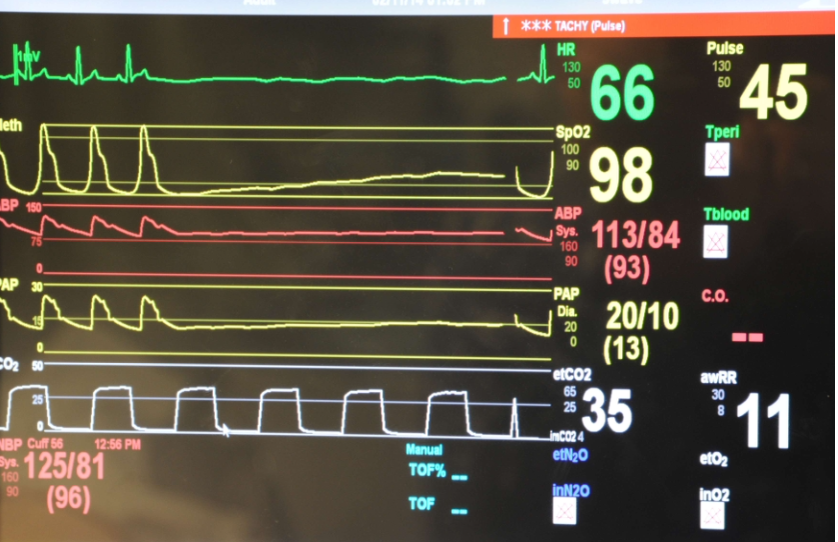
- Signal examples:
- ECG heart signals
- EEG brainwave signals
- EMG muscle signals
- Standard requested by DICOM WG32 Neurophysiology
- Project launch in ITU-T, being joined by MPEG Audio
- ITU Call for Proposals in April 2024, evaluation January 2025
- Focus on near-lossless to lossless coding
- Draft text and software available
- Target completion July 2026
Developments in graphics coding
- Point Cloud Compression
- Video-based PCC (V-PCC): ISO/IEC 23090-5
Finalized v1 (2023), with ongoing improvements in V3C integration and metadata - Geometry-based PCC (G-PCC): ISO/IEC 23090-9
Finalized v1 (2023), v2 near publication (support for dynamic sequences, improved
inter-frame coding) - AI-based PCC (AI-PCC): in progress
Leverages learned prediction and compression models, Compression gains
demonstrated on sparse/dynamic content
- Video-based PCC (V-PCC): ISO/IEC 23090-5
- Dynamic Mesh Compression
- Video-based Dynamic Mesh Compression (V-DMC): ISO/IEC 23090-29
in progress – Efficient coding of animated meshes using video codecs
- Video-based Dynamic Mesh Compression (V-DMC): ISO/IEC 23090-29
- Gaussian Splat Representation and Coding (GSC)
- Exploratory activity under MPEG 3DGC (WG 7) and Video (WG 4)
Focus on high-quality, real-time renderable representations
Aligns with neural graphics pipeline
Dataset and benchmark established; call for proposals expected in 2026
- Exploratory activity under MPEG 3DGC (WG 7) and Video (WG 4)
- Haptics: ISO/IEC 23090-31
- Compression of haptic timelines and spatial signals
Genomic coding ISO/IEC 23092
- Part 1: Transport and storage of genomic information:
- Data formats for both transport and storage of genomic information,
including the conversion processes and the indexing technology
- Data formats for both transport and storage of genomic information,
- Part 2: Coding of genomic information
- Coding technology for references and genomic reads
- Part 3: Metadata & application formats interfaces (APIs)
- Information metadata, metrics metadata, clinical data linkage metadata,
auxiliary fields, SAM interoperability, protection metadata and APIs
- Information metadata, metrics metadata, clinical data linkage metadata,
- Part 4: Reference software
- Part 5: Conformance
- Part 6: Coding of genomic annotations
- Compressed representation of genomic annotations of type: variants with
genotyping, functional annotations, tracks, expression and contact matrices
(from Hi-C experiments)
- Compressed representation of genomic annotations of type: variants with
- Part 7: MPEG-G application formats and profiles
- Use case oriented structuring of genomic data and associated profiles